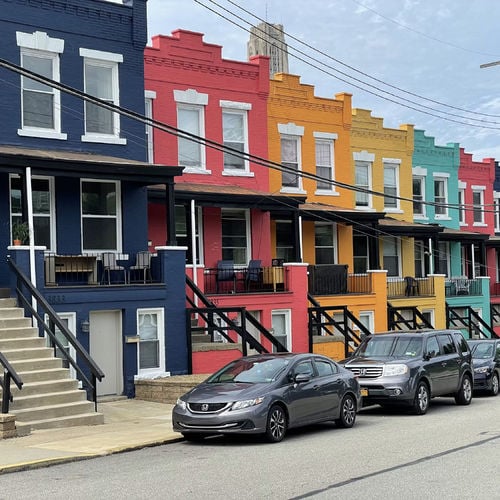





How Much House Can You Actually Afford in Philadelphia on a $100K Salary?
Quick Answer: Using the standard 28/36 rule at today's rates, someone earning $100,000 a year can typically afford a home in the $300,000-$390,000 range depending on down payment size and existing debt — with a baseline of roughly $303,686 at 10% down, stretching up toward $453,348 with 20% down and no other debt. That range actually lines up well with Philadelphia's current citywide median of $294,805, which is part of why the city stays attractive to buyers who'd get priced out of the suburbs on the same income.
I get asked some version of "what can I actually afford" more than almost any other question, and I always tell clients the honest truth up front: the number a lender pre-approves you for and the number you should actually spend are not always the same thing. Let's walk through the real math.
What does the 28/36 rule actually mean for a $100K salary?
The 28/36 rule says no more than 28% of your gross monthly income should go toward housing costs (mortgage principal, interest, taxes, and insurance combined), and no more than 36% toward all your debt payments combined, including student loans, car payments, and credit cards. On a $100,000 salary, that's about $8,333 in gross monthly income — 28% of that is $2,333 a month for housing, and 36% is $3,000 a month for total debt. If you have no other debt, you can push closer to that full 36%, which is where the higher affordability estimates come from. If you're carrying a car payment and student loans, your real number drops fast, sometimes by $50,000-$100,000 in home price.
How much does down payment size actually change what you can afford?
A lot more than most buyers expect. With 10% down and no other debt, a $100K earner typically lands around $390,454 in home price. Push that to 20% down and you're looking at roughly $453,348 — a $63,000 swing just from the down payment percentage, because a bigger down payment shrinks your loan amount and often gets you a slightly better rate tier. On the other end, an FHA loan with 3.5% down puts you closer to $370,124 — a smaller down payment but still a real path to homeownership if saving 20% isn't realistic on your timeline.
What does Philadelphia's property tax actually do to the math?
Philadelphia's combined city and school district property tax rate currently sits at 1.3998% of assessed value — worth knowing because it's higher than some surrounding suburbs, and it's baked directly into that 28% housing-cost number. On a $300,000 home, that's roughly $4,200 a year, or $350 a month, just in property tax — money that's competing with your principal and interest payment for the same $2,333 monthly housing budget. This is exactly why running your own numbers on a specific address matters more than trusting a generic affordability calculator, since tax rates and assessed values vary block to block.
Are there programs that actually help a $100K earner buy in Philadelphia?
Yes — Philly First Home offers eligible first-time buyers up to $10,000 or 6% of the purchase price toward down payment and closing costs, with income limits that a single $100,000 earner may or may not clear depending on household size, so it's worth checking your specific eligibility rather than assuming you're priced out of the program. Between a program like that and an FHA loan's lower down payment requirement, a $100K salary has more real paths into Philadelphia homeownership than the headline "you need 20% down" myth suggests.
What actually changes this math the most?
Two things, in order: existing debt, and interest rate. Paying off a car loan before you start house hunting can meaningfully expand your budget, sometimes more than saving an extra $10,000 for a down payment would. And every quarter-point move in mortgage rates shifts your affordable price range by roughly $10,000-$15,000 in either direction — which is part of why I tell clients not to obsess over timing the rate perfectly and instead focus on what they can control: their debt load and their down payment.
Brett's Take
The generic online calculators aren't wrong, but they're built for a "typical" buyer who doesn't exist — they don't know your actual property tax rate, your actual insurance quote, or whether you're eligible for a program like Philly First Home. I'd rather run real numbers with you on two or three specific neighborhoods than hand you one national number and call it a day, because the honest answer to "what can I afford" is always more specific than a single dollar figure.
Final Verdict
On $100,000 a year, most buyers can realistically afford somewhere between $300,000 and $390,000 in Philadelphia depending on debt and down payment — which happens to line up closely with the city's current median, making Philadelphia proper one of the more realistic markets in the region for this income level compared to many surrounding suburbs.
Find Out Your Real Number
Generic calculators only get you so far — run your specific scenario with my mortgage calculator, or check out financing options including down payment assistance programs you may qualify for.
FAQ
How much house can I afford on $100,000 a year in Philadelphia? Typically between $300,000 and $390,000, depending on your down payment size and existing debt, using the standard 28/36 affordability rule at current rates.
What down payment do I actually need to buy a house in Philadelphia? It varies — FHA loans allow as little as 3.5% down, while conventional loans often require 5-20%; a bigger down payment lowers your monthly payment and loan amount but isn't strictly required to buy.
Does Philadelphia have first-time homebuyer assistance programs? Yes — Philly First Home offers up to $10,000 or 6% of the purchase price for eligible first-time buyers toward down payment and closing costs, subject to income limits.
How much is property tax on a $300,000 home in Philadelphia? At the city's combined 1.3998% rate, roughly $4,200 a year, or about $350 a month — a real factor in your total monthly housing budget.
Does paying off debt before buying actually help that much? Yes, often more than saving an additional down payment — eliminating a car payment or reducing credit card debt can meaningfully raise the home price you qualify for under the 36% total-debt guideline.
Brett Rosenthal, Realtor — Revolve Philly Group at Compass. Equal Housing Opportunity.
Check out this article next